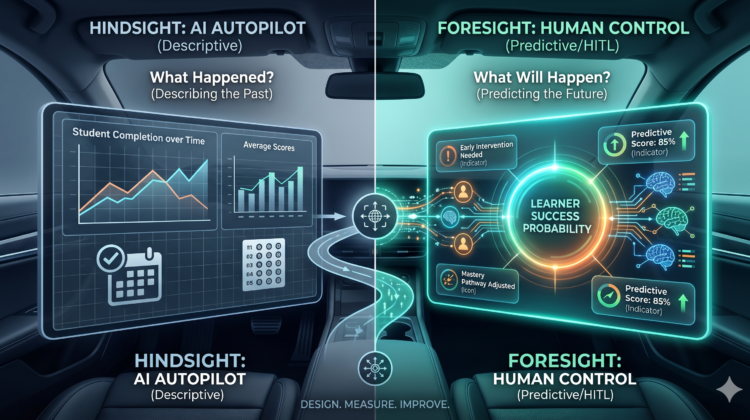
AI is the Engine, You are the Steering Wheel: The Necessity of the “Human-in-the-Loop”
Generative Artificial Intelligence can draft a 10-module course outline, write assessment questions, and generate branching scenario scripts in under 60 seconds. But is it a good course?
As the Learning and Development (L&D) sector rushes to integrate Large Language Models (LLMs) such as Claude, Gemini, and ChatGPT, a troubling misconception has emerged: the idea that AI can replace the Instructional Designer. However, the truth about the uneven technological landscape is quite the contrary. AI serves as a remarkably powerful tool for generating content, but without human guidance, it can swiftly lead your curriculum into a pit of bias, cognitive overload, and misalignment with pedagogical goals.
In 2026, the primary value of an Instructional Designer is no longer just content creation; it is AI Governance. It is time to master the “Human-in-the-Loop” (HITL) framework.
The Danger of "Autopilot" Learning Design
When we hand over the keys entirely to an LLM, we expose our learners to significant risks. LLMs operate on probabilistic prediction—they output what is statistically likely to follow a prompt, not necessarily what is pedagogically sound or factually accurate (Mollick & Mollick, 2023).
This dependence on statistical likelihood results in “hallucinations”—believable yet completely invented information. Additionally, LLMs lack contextual awareness. An AI is unaware of the specific reading abilities of the middle school students I instruct, nor can it grasp the intricate cultural dynamics of a classroom compared to those of a corporate boardroom. When AI operates without oversight, it produces generic, “one-size-fits-all” instructions that research consistently shows fail to engage diverse learners or foster deep cognitive processing (Lodge et al., 2023).
The "Human-in-the-Loop" (HITL) Framework
The solution is not to reject AI, but to govern it. The HITL framework, originally a concept in machine learning data training, is now the most critical methodology for modern Instructional Designers.
HITL dictates that an AI system should never be fully autonomous in high-stakes environments like education; a human expert must review, refine, and approve the output (Dell’Acqua et al., 2023).
Here is what that looks like in my daily workflow when building digital architecture or structuring project-based learning:
- The AI as the Ideation Engine: I use AI to conquer the blank page. I will prompt an LLM to generate the initial Python logic for a learning analytics script or draft the raw text for a 3D-printing safety module in Articulate 360.
- The Human as the Architect: I step in to apply learning science. I strip away the AI’s verbose language to reduce cognitive load. I inject empathy and real-world relevance, and I ensure the branching logic actually tests capability rather than just memorization.
- The Human as the Fact-Checker: I verify the code’s technical accuracy, the data’s validity, and the scenarios’ cultural competence.
The Evolution of Our Profession
We are shifting from being the writers of instruction to the editors and architects of learning ecosystems.
In the lab, the focus is on teaching the next generation of engineers and analysts the skills necessary for effective coding in automated robotics. Students are permitted to utilize AI assistance for code writing; however, they are required to explain the logic of their code in detail, ensuring they maintain the role of a human-in-the-loop.
Instructional Designers face competition from AI due to its speed. However, by positioning themselves as experts who govern, refine, and contextualize AI, they can enhance their value and relevance in the field.
Design. Measure. Improve
References
- Dell’Acqua, F., McFowland, E., Mollick, E. R., Lifshitz-Assaf, H., Kellogg, K., Rajendran, S., Krayer, L., Candelon, F., & Lakhani, K. R. (2023). Navigating the jagged technological frontier: Field experimental evidence of the effects of AI on knowledge worker productivity and quality. Harvard Business School Technology & Operations Mgt. Unit Working Paper No. 24-013. https://doi.org/10.2139/ssrn.4573321
- Lodge, J. M., Howard, S., & Bearman, M. (2023). Understanding the impact of generative artificial intelligence on higher education. Higher Education Research & Development, 42(5), 1033-1036.
- Mollick, E. R., & Mollick, L. (2023). Using AI to implement effective teaching strategies in classrooms: Five strategies, including prompts. The Wharton School Research Paper. https://doi.org/10.2139/ssrn.4391243