The End of “Hindsight” Analytics: Moving from Descriptive to Predictive Learning Design
Stop reacting to training failures after they happen.
If you are only looking at basic Canvas completion rates, you are designing in the past. In the rapidly evolving landscape of instructional design, the reliance on end-of-module surveys and final quiz scores is no longer enough to ensure student success. True learning analytics is about forecasting outcomes before the module ends. It is time to transition from “hindsight” analytics to predictive learning design.
The Trap of Descriptive Analytics
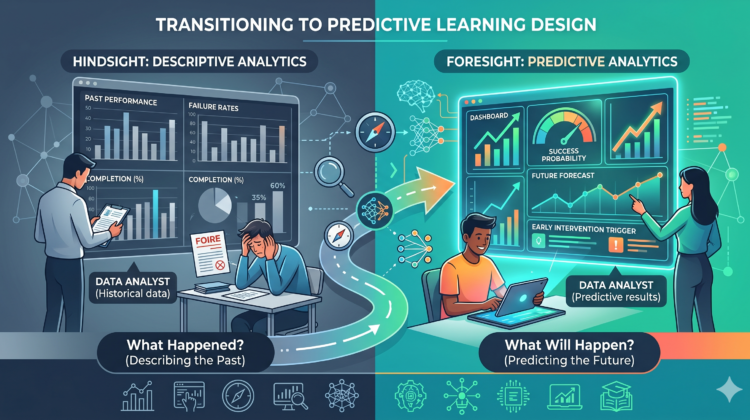
Historically, education and corporate learning and development (L&D) have relied on descriptive analytics. This methodology answers a simple question: What happened? It encompasses data points like completion rates, average time spent on a page, and final assessment scores.
While descriptive data is essential for administrative benchmarking, it acts entirely in hindsight. By the time an instructor or learning analyst realizes a student has failed to grasp a core concept, the learning opportunity has already passed. The student has disengaged, and the instructor is left reacting to a failure rather than preventing it. As Siemens (2013) noted early in the evolution of the field, the true potential of educational data lies not in reporting the past, but in optimizing the future of the learning environment.
Mining for Foresight: Enter Predictive Analytics
Predictive analytics answers a much more valuable question: What will happen next? Instead of waiting for a final grade, predictive models ingest real-time signals to forecast future outcomes. These models track early engagement patterns, login frequencies, hesitation points in interactive modules, and resource consumption. Recent systematic reviews show that advanced analytical models consistently outperform traditional statistical models in forecasting student performance and identifying at-risk learners early in their academic journey (Almalawi et al., 2024).
This is where the role of the modern Instructional Designer transitions into the Learning Analyst. By utilizing data mining tools like SQL and Python to extract backend clickstream data, we can bypass the shallow reports generated by standard Learning Management Systems (LMS). When that raw data is visualized through dashboards in Power BI or Tableau, hidden learning friction becomes visible.
Applying the Theory: From the Lab to the Dashboard
This shift from reactive to proactive design fundamentally changes how the curriculum is structured.
In a project-based learning environment, waiting for a student’s 3D-printed prototype to fail at the end of the quarter is inefficient.
Instead, by tracking early assessment data and modular progress in platforms like Articulate 360, we can identify exactly where a learner’s computational logic is breaking down. We can flag an at-risk student weeks before the final project is due.
The "Human-in-the-Loop"
However, the data is not the solution; the data helps you find the solution. Predictive analytics serves as an early warning system, but it requires an educator to execute the intervention. Research consistently demonstrates that early identification of at-risk behavior only improves retention and mastery when paired with targeted, personalized support from an instructor (Alyahyan & Düştegör, 2020).
A beautifully designed instructional module means absolutely nothing if we cannot guarantee it drives performance. We must move beyond simply building content and start engineering responsive ecosystems.
Design. Measure. Improve
References
1. Almalawi, A., Soh, B., Li, A., & Samra, H. (2024). Predictive models for educational purposes: A systematic review. Big Data and Cognitive Computing, 8(12), 187.
2. Alyahyan, E., & Düştegör, D. (2020). Predicting academic success in higher education: Literature review and best practices. International Journal of Educational Technology in Higher Education, 17(1), 3.
3. Siemens, G. (2013). Learning analytics: The emergence of a discipline. American Behavioral Scientist, 57(10), 1380-1400.