Introduction
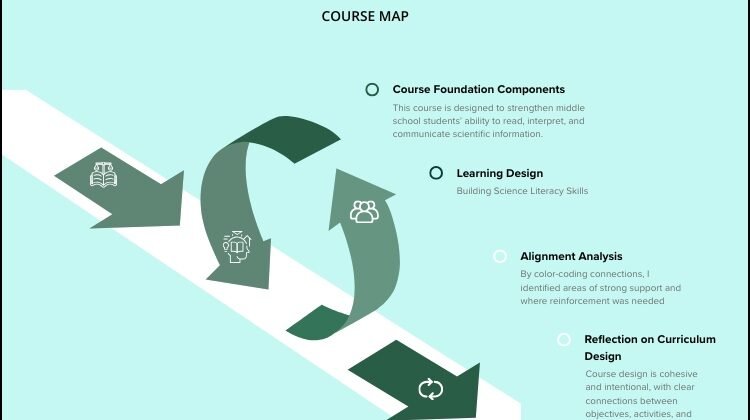
Effective curriculum design is more than selecting topics; it is the strategic architecture that bridges the gap between learner needs and desired performance outcomes. In this section, I present “Building Science Literacy Skills,” a targeted curriculum designed to strengthen data interpretation and evidence-based reasoning for middle school students.
This project demonstrates my ability to utilize backward design principles to create a cohesive learning experience. Starting with a detailed learner analysis, I identified that while students were motivated by real-world applications, they struggled with the fundamental literacy skills required to communicate scientific concepts.
The centerpiece of this artifact is the Alignment Analysis. By mapping Course Objectives (COs) against module-level activities and assessments, I ensured that every learning resource, from SAVVAS Elevate Science to STEMScopes, served a specific, measurable purpose. This rigorous process enabled me to identify and eliminate redundancies, ensuring that critical skills, such as collaboration and digital communication, were not only taught but also authentically assessed through a capstone portfolio.
Key Competencies Demonstrated:
1. Needs Analysis & Learner Profiling: Designing for diverse learner groups, including English Language Learners (ELL) and students with IEPs.
2. Constructive Alignment: Ensuring logical congruence between objectives, instructional strategies, and assessments.
3. Data-Driven Iteration: Using alignment data to refine curriculum flow and address gaps in formative assessment.
Reflective Narrative: The Power of Alignment Analysis
The Process
To ensure the integrity of the “Building Science Literacy Skills” curriculum, I conducted a rigorous alignment analysis using a color-coding highlighting method. By visually mapping module objectives to their corresponding assessments and resources, I was able to test the validity of the curriculum architecture, moving beyond surface-level content selection to ensure true instructional coherence.
Key Findings & The “Gap”
The visualization immediately highlighted the curriculum’s strengths: “Science Literacy” and “Evidence-Based Reasoning” were heavily saturated across objectives and assessments, confirming a strong core focus. However, the analysis also exposed a critical design gap. While “Collaboration” and “Communication” were required for the summative capstone project, they were significantly underrepresented in the formative stages.
I realized that without earlier, low-stakes opportunities to practice these skills, learners might struggle with the final performance task. The design was asking students to demonstrate a skill in the final module that had not been sufficiently scaffolded in earlier modules.
Design Iteration Addressing this insight, I refined the curriculum flow to bridge these gaps. I implemented specific formative interventions, such as structured peer reviews of evidence-based explanations and small-group data presentations, prior to the summative assessment. This adjustment ensured that the “Communication” objective was not just an aspiration, but a measurable outcome supported by meaningful practice.
Professional Growth
This process reinforced that instructional design is an iterative science. Alignment analysis is not merely a checklist exercise; it is a mechanism for accountability and validity. It ensures that we are not just teaching content, but actively engineering an environment where every objective is measurable, and every student is supported in their journey toward mastery.
Assessment Strategy: Moving Beyond the Test
Philosophy: Authentic Performance
For the “Building Science Literacy Skills” course, I rejected traditional selected-response exams in favor of a Science Literacy Portfolio & Presentation. Traditional testing often isolates individual skills, whereas science literacy requires the synthesis of reading, interpretation, and communication skills. A portfolio approach enables authentic, performance-based assessment, reflecting the complex tasks learners will encounter in high school STEM pathways.
The Strategy in Action
The assessment strategy is designed to be holistic and evidence-driven. By curating a portfolio of three distinct artifacts, an annotated article analysis, a data interpretation task, and a written evidence-based explanation, learners demonstrate mastery across all course objectives rather than just recalling facts.
Integration of Soft Skills
Crucially, this strategy bridges technical analysis with social learning. The inclusion of a collaborative capstone presentation ensures that Communication (CO5) is assessed with the same rigor as Data Interpretation (CO2). This dual focus addresses the learner’s need for interactive and collaborative instruction, while ensuring that students can not only understand science but also communicate it effectively to others.
Tools & Technologies: Strategic Resource Selection
Selection Criteria
To support the diverse learner profile of this magnet school setting, including ELL students and those with IEPs, I selected a blend of core curriculum resources and digital tools. My selection criteria prioritized accessibility, interactive simulation, and opportunities for scaffolded practice.
Core Learning Technologies
1. Instructional Foundation: SAVVAS Elevate Science
Purpose: Chosen as the primary curriculum resource to build foundational science literacy.
Design Rationale: Its structured lessons and accessible texts provide the necessary scaffolding for students struggling with reading comprehension, ensuring the “Content” is accessible before asking students to analyze it.
2. Inquiry & Data Analysis: STEMScopes
Purpose: Used to support Module 2 (“Making Meaning from Data”) through inquiry-based tasks and digital simulations.
Design Rationale: This tool facilitates a transition from passive reading to active application. The digital simulations allow students to manipulate variables and generate their own data sets, directly supporting the objective of interpreting charts and graphs.
3. Differentiation & Reinforcement: Khan Academy & Spectrum Science
Purpose: Khan Academy provides video-based reinforcement and interactive practice for visual learners, while Spectrum Science offers leveled reading passages.
Design Rationale: These resources provide “multiple pathways” for accessing content. Khan Academy enables self-paced remediation on graphing skills, while leveled readers support English Language Learners (ELLs) by building vocabulary without compromising rigor.
4. Collaborative Documentation: Engineering Design Notebook
Purpose: A tool for documenting collaborative problem-solving.
Design Rationale: This resource directly supports the collaboration objective (CO5), serving as a structured space for students to record their group’s reasoning before presenting their findings.
Future Iterations: Recommendations for Improvement
Commitment to Continuous Improvement
The alignment analysis revealed that while the curriculum foundation is strong, specific refinements could further enhance validity and learner engagement. Based on my findings, I proposed the following iterations to strengthen the course design:
1. Scaffolded Communication Practice: To address the gap in formative assessment, I recommend introducing low-stakes opportunities for collaboration prior to the capstone. Specifically, incorporating structured peer reviews of written explanations and small group data presentations would allow students to practice these skills in a supportive environment.
2. Increased Data Frequency: While data interpretation is a core objective, the analysis suggested that increasing the frequency of these tasks throughout the modules would ensure learners feel equally confident in this skill as they do in general literacy.
3. Refining Rigor with Bloom’s Taxonomy: To maximize clarity and assessment validity, I identified a need to review all assessment language. Ensuring that every task utilizes measurable verbs aligned strictly with Bloom’s Taxonomy will guarantee that the cognitive rigor matches the stated learning objectives.
Designing For Impact
| Erick Bugah | IDT |